That high-pitched squeaking sound when you apply the brakes is certainly annoying. But many drivers simply turn up their music and hope it goes away. They assume a little noise is normal and the brakes still stop the car, so it cannot be that serious.
Here is the uncomfortable truth: brake pad squeakers exist for a very specific reason. That sound is produced by a small metal indicator tab built into the brake pad assembly. When the friction material wears down to roughly 3mm thickness, this tab contacts the brake rotor to produce a deliberate audible warning.
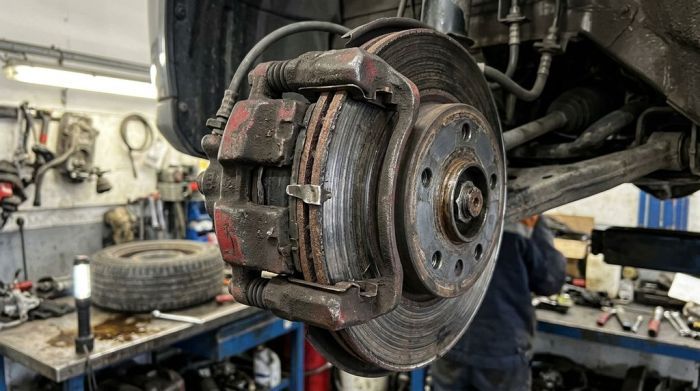
If the squeaking stops on its own, do not be relieved. It does not mean the problem fixed itself. It means the indicator tab has worn off completely — and now your brake pad's metal backing plate is grinding directly against the brake rotor. This is called metal-on-metal contact, and it is doing severe damage with every mile you drive.
At this point, your brake rotor is being gouged and scored with every single stop. A rotor that could have been resurfaced for $20 now needs a full replacement costing $200 to $500 per axle. You have also significantly increased your stopping distance, especially in emergency situations or wet conditions.
Beyond the rotor damage, you risk overheating your brake calipers and warping them permanently. A seized caliper causes uneven braking, pulls your car to one side, and ruins the new pads you will eventually install. The repair costs compound quickly.
The better approach: Inspect your brake pads every 15,000 miles or once a year. Replace them when the friction material is down to 3mm — about the thickness of a dime. Quality replacement pads cost $50 to $150 and will save you from a $500 or more rotor replacement bill down the road.